By Rob Hedelt – Board Member and Retired Journalist
When visitors come to the party at Lawson Bay Farm in a few weeks to celebrate the conservation of open land and working farms, Venue Sponsors and hosts Marcia and Robby Robison hope they leave with a little of the love they feel for the bucolic acreage in White Stone between White Stone Beach and Mosquito Point.
The event being held there on October 3rd is Northern Neck Land Conservancy’s Boots and Barbecue, an annual celebration of the rural character of the Northern Neck and Essex County.
Aside from providing all the fried oysters and barbecue that a ticket holder could ever desire, the occasion supports the Land Conservancy’s central goal: to protect working farms, waters, wetlands and woodlands in the region.
In addition to the delicacies that make for many returning customers, the event also features live music, exhibitors and demonstrations that reflect the unique way of life in the region. A tour of the historic home will also be featured.
Because tickets typically sell out, people who would like to attend or to support the mission as sponsors are advised to visit the Conservancy’s website at nnconserve.org, and hit the blue Become a Sponsor or Buy Tickets buttons on the home page. (Note that sponsorship benefits include various quantities of event tickets.)
Once there, eventgoers can find out more about the Land Conservancy’s mission and how people who share a desire to protect important natural areas from development can get involved in that effort.
Robby Robison was six years old in 1947 when his family moved from Arlington in Northern Virginia to a pastoral property on the Rappahannock River in Lancaster County that became known as Lawson Bay Farm.
Knowing that a good-sized crowd will get to experience the beautiful waterside spot that he is happy to protect, Robby Robison has one big hope about what visitors will take away from Lawson Bay Farm.
“I just hope these visitors will leave knowing that places like this can be preserved,” said Robison when members of the Land Conservancy visited the spot recently to plan for the event.
Memories of hunting, swimming, fishing, trapping and enjoying the beautiful backdrop of the Rappahannock River spurred the family to protect the 75-acre spot that provides beautiful vistas throughout the property.
“I just love this place,” he said. “I couldn’t stand the idea of it being developed, becoming filled with the houses you see going up all around it.”
To the outdoor-loving Robison, his father’s decision to retire from the Navy after World War II to the area where his mother grew up meant that life “became summer camp, all the time.”
“It was and is such a wonderful spot,” he said of his family’s farm that includes a renovated and expanded ‘four over four’ colonial home, stands of tall pines and fields leased to local farmers.
Robison said that from the day his family moved onto the land—not far from the at-one-time lively White Stone Beach that his father actually visited in 1940 on his Navy destroyer—he reveled in the outdoor life.
“I hunted every day, fished every day,” he said, noting that a relative taught him how to trap and helped him set up his own trap line. There were times he checked the day’s catch as early as 3 AM and Robison still remembers today just how bright the Milky Way would shine at that time.
“I could make a couple hundred dollars a year trapping muskrat and the occasional mink, selling them to an old guy from Sears & Roebuck who’d come down in the spring in his old Ford to buy the skins I’d scraped and dried,” he said.
Beyond that, his mother’s family was a large one— “at one point, I had 45 cousins or so here”—which would gather at his home or one of theirs for potluck lunches out under the trees after church on Sunday.
Robison eventually ended up moving his family out to Long View, Washington, where he worked as an ophthalmologist for 30 years. He still lives there for most of the year, though after retiring Lawson Bay Farm has again become a big part of life.
His mother lived there until 1972, and when Robison retired in 2000, he and wife Marcia expanded their return visits, coming a handful of times each year and staying for a month or more at a time.
Over the years, Robison noted that his family grew to feel a connection to the peace and quiet of the spot, with wife Marcia easing into a program where birds get copious feed, deer get apples and turkeys strut around the property like it’s theirs.
A discussion a few years back with one of his cousins who was putting a conservation easement on his own family farm in the Merry Point area spurred Robison to start looking at doing the same to preserve Lawson Bay Farm.
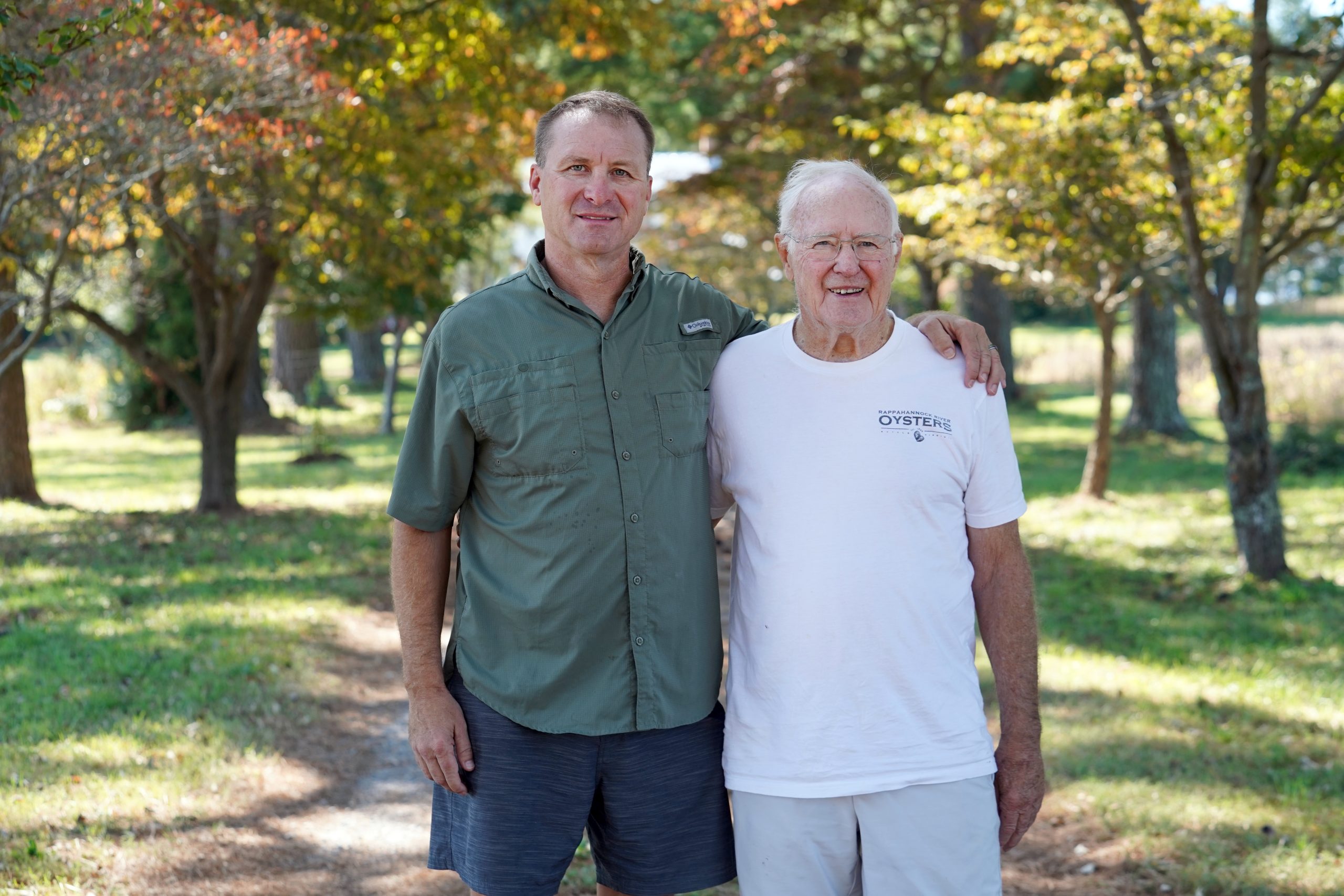
His son, Gunn Robison, is now the owner of the property that’s held in a trust. Gunn shared his father’s desire to protect the land from development and finished the process by putting in place a conservation easement through the Northern Neck Land Conservancy. The agreement means that Lawson Bay Farm’s 75 acres will stay undeveloped, although it does allow farming and many other non-developmental uses to continue.
“What’s special here is the beauty, the unspoiled nature of this spot and the history of the house, which goes back to 1836,” said Gunn Robison, who also lives in Washington State but said he and his wife Dana have found ways to spend more time at Lawson Bay Farm now that he’s retired. His college-aged children have as well, and appreciate what’s unique about the now-protected spot on the river.
“I want it to stay like it is,” said Gunn. “And my kids have enough sense of history and their own enjoyment here that they want to be able to come back as well. They are now adults, and will start having families, and I want them and their children to be able to come back here and have it be exactly as it is now, a very special place.”
Gunn said what may have cemented that feeling was a sabbatical he took from a job in the tech industry that allowed a long stay one year when their children were all between the ages of 4 and 10.
“It was funny during that time we spent how this place imprinted on our kids,” he said. “They had such a great time, getting to know some of their cousins and focusing on family, the property and the environment here.”
Robby said he was glad to see that his grandchildren were also entranced by the wildlife, the river out front and the sense of peace and quiet unlike the city where they lived.
It reminded him of the days in his own youth when he’d scoop soft crabs out of the stands of sea grass out in the river, or watch his family’s Chesapeake Bay retriever Penny who had her own unique way of catching the beautiful swimmers.
“Crabs were thick here then, you could stand on the shoreline and watch them go by,” he said. “If Penny saw one, she would grab it and toss him up on the bank. When Penny saw them, she would actually spend all afternoon happily picking up crabs in her mouth and piling them on the beach.”
He noted that the Lawson Bay Farm history dates back to 1651 when Epaphroditus Lawson, an immigrant from England, patented the tract. The Lawson family kept much of the land they settled in Lancaster County together through multiple generations, farming the land into the 1900s.
“Around the year 1900 or 1901, a descendant named Bettie Lee Lawson sold her portion of the land to Richard H. Payne, and he opened a mill here,” said Robison, noting that when it didn’t go well, the land was auctioned off and then sold again in 1901 to Hansford Bayton, the local legend was a very successful Black businessman who operating a series of steamboats.
Robison noted that Bayton owned the farm for 15 years, then sold off part of the land to another Black family by the name of Churchill who created a summer resort for Black visitors when he was growing up. “It’s still a sort of Black retirement community, all good neighbors,” he said.
Robison has become somewhat of a historian of the property, publishing a book called The Lawsons of White Stone and Lawson Bay Farm: 1650 to Present Day in 2020.
Robison says he sees Hansford Bayton’s ownership as another fascinating chapter in the history of the property, joining the natural beauty and peaceful setting that he and his whole family are glad to have protected for the future.
–
For more information about the Northern Neck Land Conservancy, visit their website at nnconserve.org or call its office in Warsaw at 804-250-2334.
Story by Rob Hedelt, a board member of the Northern Neck Land Conservancy, who for 44 years was a reporter and columnist at the Free Lance-Star newspaper in Fredericksburg.
Some parts of this story were included in an earlier story about how the Lawson Bay Farm conservation easement was established.
Robison has become a historian of the property, publishing a book called The Lawsons of White Stone and Lawson Bay Farm: 1650 to Present Day in 2020. https://www.amazon.com/Lawsons-White-Stone-Lawson-Present/dp/1957928077