
By Rob Hedelt
When visitors arrive on October 3rd at Lawson Bay Farm in White Stone for Boots and Barbecue, the Northern Neck Land Conservancy’s annual celebration of land conservation efforts in the region, the picturesque property on the Rappahannock River will have many stories to tell.
One of the most recent is the story of how the current owners, the Robison family, placed a conservation easement on the 75-acre farm to help ensure that it will never be developed — that its open, natural spaces will still be here for future generations.
Another story dates back to the 1890s and the early 1900s, when a Black entrepreneur, Hansford C. Bayton, became the respected captain and owner of five steamboats that delivered mail and passengers from the Northern Neck and Middle Peninsula to Baltimore, Norfolk and Washington.
Although Rowland Lawson once owned 900 acres stretching from Cherry Creek out onto Mosquito Point, over the years parcels were divided for his descendants and transferred to other owners. Along the way, in 1901, Bayton purchased 169 acres – the house and surrounding land now known as Lawson Bay Farm. The acquisition was a groundbreaking act for a man of color in that era.
Visitors to this year’s Boots and Barbecue event—where fried oysters join barbeque, beer, wine and all the fixings—will be able to learn more about Bayton and his fleet of mail-delivering steamboats from the local experts on that chapter of maritime history: the Steamboat Era Museum in Irvington.
The museum, which has an ongoing exhibit telling Bayton’s story, will have a contingent at this year’s Boots event to share tales of his achievements, as well as the broader story of the time when steamboats made the region’s waterways the prevailing lanes of commerce.
In addition to the Boots and Barbecue food delicacies, the event also features live music from the popular group the Gurleys and Fiddlesticks, as well as exhibitors and demonstrations that reflect the rural character of the Northern Neck and Essex County.
Because tickets typically sell out, those wanting to attend or help to support the event as sponsors are advised to visit the Land Conservancy’s website at nnconserve.org and click the blue Buy Tickets button.
Once there, visitors can find out more about the Land Conservancy’s mission and how people who share a desire to protect important natural areas from development can get involved in that effort.
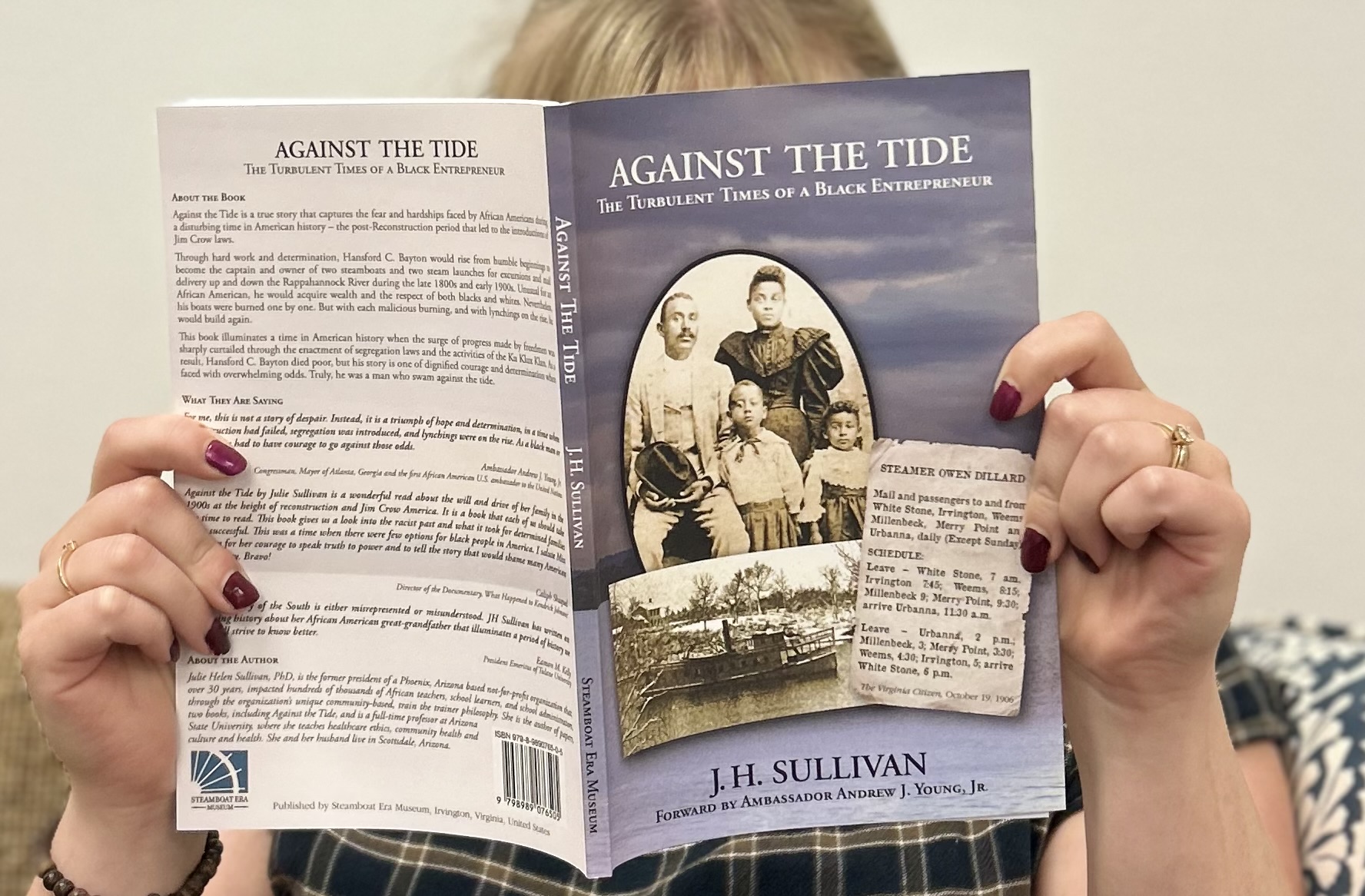
Helping to bring the tale of Hansford Bayton to life has been no other than his great-granddaughter, Julie Sullivan, who wrote a fascinating account of the man titled Against the Tide: The Turbulent Times of a Black Entrepreneur.
Writer Rob Hedelt talked to Sullivan several years back when the book and exhibit at the Steamboat Era Museum in Irvington were both new, and again recently by phone to get her thoughts on her great-grandfather’s life being shared at Northern Neck Land Conservancy’s big annual fun- and fund-raising event.
“What I’d like visitors to know is that he was a unique individual for the times he lived in,” said Sullivan, a college professor who lives in Arizona. “My great-grandfather became a model for Whites and Blacks alike in Virginia, a model of accomplishment, integrity and perseverance.” Captain Bayton was an election judge in White Stone, making him one of the few Black men during the Jim Crow era to hold public office.
She added, “It’s very likely that his model opened doors for other Blacks, not only on the water but also in other areas of business for those who had the drive, intelligence and ethics to achieve.”
From the time she was a little girl, Sullivan heard stories about how her great-grandfather, Captain Bayton, was a man ahead of his time.
As she got older, Sullivan knew that the story of the man known to all simply as “Cap’n Hanks” needed to be told.
On a visit to Virginia for the opening of the Steamboat Era Museum’s exhibit, Sullivan noted that she used everything from family history to newspaper clippings and more to tell Bayton’s story, starting when he was born in 1863 to Julia Bayton née Holmes.
Although Julia was a house slave, most likely at a plantation called Cherry Hill in Essex County near Dunnsville, Hansford was born free under the Emancipation Proclamation. Bayton’s father was a Native American, a member of the Powhatan Indian Tribe. The author said Bayton’s father’s heritage carried a stigma that she believes drove him to work extra hard to achieve a life and lifestyle that rose above it.
She points out that her great-grandfather was educated and had gained a stable home when his mother later married a man named Arthur Bayton, the adoptive father who gave the youth his name.
Sullivan said her great-grandfather worked on Julia and Arthur Bayton’s small family farm in Essex County near Tappahannock for a while. Eventually, though, he was called to work as a waterman, seeing more opportunity on the Rappahannock River than the loamy soils of the Middle Peninsula.
Bayton’s big break came when he went in with a partner to buy a 39-foot steamboat called the Owen Dillard in 1895 and then applied for and got a contract to provide mail service between wharves in Middlesex and Lancaster counties.
Sullivan’s book notes that it’s likely no one knew that Bayton was Black when his contract was approved, as there was no picture attached and no interview conducted.
Getting the contract moved Bayton’s focus and his family to Lancaster County, where he eventually acquired five different boats to operate the mail and passenger service there and routes elsewhere. Captain Bayton also became an election judge in White Stone, making him one of the few black men during Jim Crow to hold public office.
Sullivan noted that buying Lawson Bay Farm came with some risk for her great-grandfather.
“He took an inordinate amount of risk just to buy this land,” she said. “He wanted to achieve parity, with people who he believed were his equals. He believed that they had no more business acumen and intelligence than he did.”
The last few chapters of Sullivan’s book show that things eventually became bleak for Bayton. During his peak business years, racial segregation laws became more entrenched. She notes that the support he had gotten from the white business community changed, especially when he backed a Black candidate in a local election. His boats appear to have been sabotaged, and though he rebuilt, his bottom line was affected to the point that he lost ownership of his steamboats.
Sullivan says in the book’s afterword that, “The story of Hansford Bayton could be taken as one of despair: a man who succeeded, against all odds, and then failed.”
But she said of the ancestor she so respects: “Despite the failure of Reconstruction, the introduction of segregation and the threat of lynchings, he carried on. Truly, he was a man who swam against the tide and for that, we admire him.”
The book Against the Tide: The Turbulent Times of a Black Entrepreneur, will be available for purchase at Boots and Barbecue, and is available at the Irvington Steamboat Era Museum. It can also be purchased online under the author’s name, J.H. Sullivan.