
By Kevin Howe – Board Member, Ecologist, Master Naturalist
Over 490 species of birds have been recorded in Virginia, and in the Northern Neck scientists and bird lovers have recorded over 140 species. Some are “overly” common, like the Canada Goose while others are very rare, like the Calliope Hummingbird. This Hummingbird has been spotted only four times in Virginia including once in Northumberland County. This western mountain species is the smallest breeding bird in the US, weighing less than a penny! Odd locality records for birds like this one pop up every year or so.
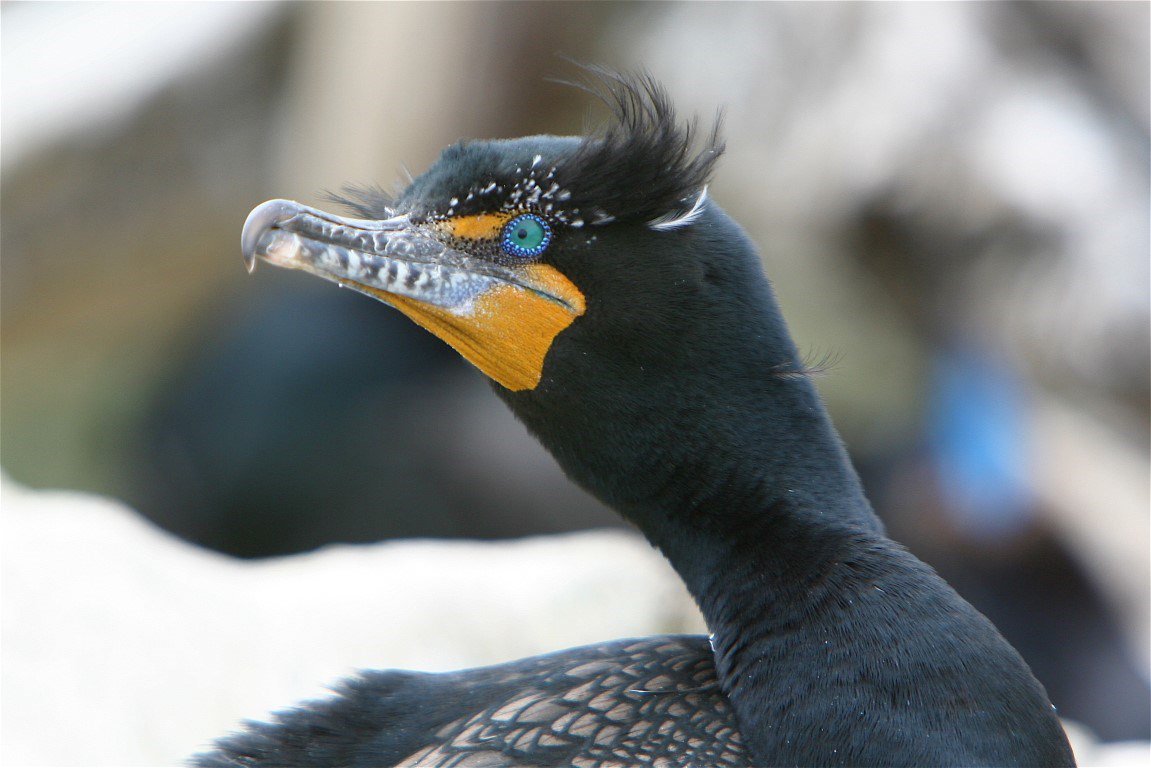
This month, we think about a fairly common but fascinating waterbird, the Double-crested Cormorant. It is by far the most common of the three species of cormorants found in Virginia. The Double-crested Cormorant occurs around lakes, rivers, bays, and coasts throughout the US and into Canada. They are a medium-sized black bird with a snakelike neck and a long, hooked bill surrounded by orange skin. Among birds, they have arguably the most beautiful turquoise to emerald green eyes with a distinctive light-colored ring around the iris. During the breeding season, a “crest” (tufts) of white and black feathers appears behind each eye.
 Cormorants were abundant in Colonial Virginia with one author in 1610 writing that in Virginia rivers, they were “in such abundance as are not in all the world to be equaled.” In the late 1800s, cormorant populations declined dramatically due to human actions including egg gathering, collecting feathers for women’s hats, being killed for food, and because they were thought to compete with humans for fish. While populations did improve in the 1900’s, they declined again when the insecticide DDT was widely used from about 1950 to 1972.
Double-crested Cormorant tends to be quite gregarious throughout the year whether during the breeding season or when they are just loafing. In our area, there appear to be some individuals that migrate south in the winter while others stay year-round. Cormorants are colonial nesters meaning they generally nest as a group in fairly close proximity to each other. While most build a platform-like nest in trees, they have been found to nest on the ground as well. They are often found in a colony with other waterbirds like egrets and herons. About 13 percent of all 11,000 known bird species are colonial nesters but 95 percent of the 350 known seabird species are colonial. This is probably an adaptation that limits their exposure to predation and a response to a shortage of nesting sites.
Cormorant nesting in Virginia was not reported until 1978, suggesting they had been migratory previously. Studies by William and Mary researchers found cormorant populations rose from one colony and six breeding pairs in 1985, to 11 colonies and over 5,000 pairs in 2018, but declined again to 2,952 pairs in 2023. The recent decline is attributed to erosion of a small island north of Tangier, Shanks Island, which was the nesting area for 80 percent of Cormorants in the Commonwealth.
 The major diet of Cormorants is fish, but they are known to eat crustaceans, insects, snakes and even voles. They are not particular in their fish diet either with over 250 fish species reportedly found in their diet. Their hooked bill is quite effective in catching fish, which are usually swallowed whole. They frequently dive to catch their prey to a depth of about 24 feet and can stay underwater for more than a minute.
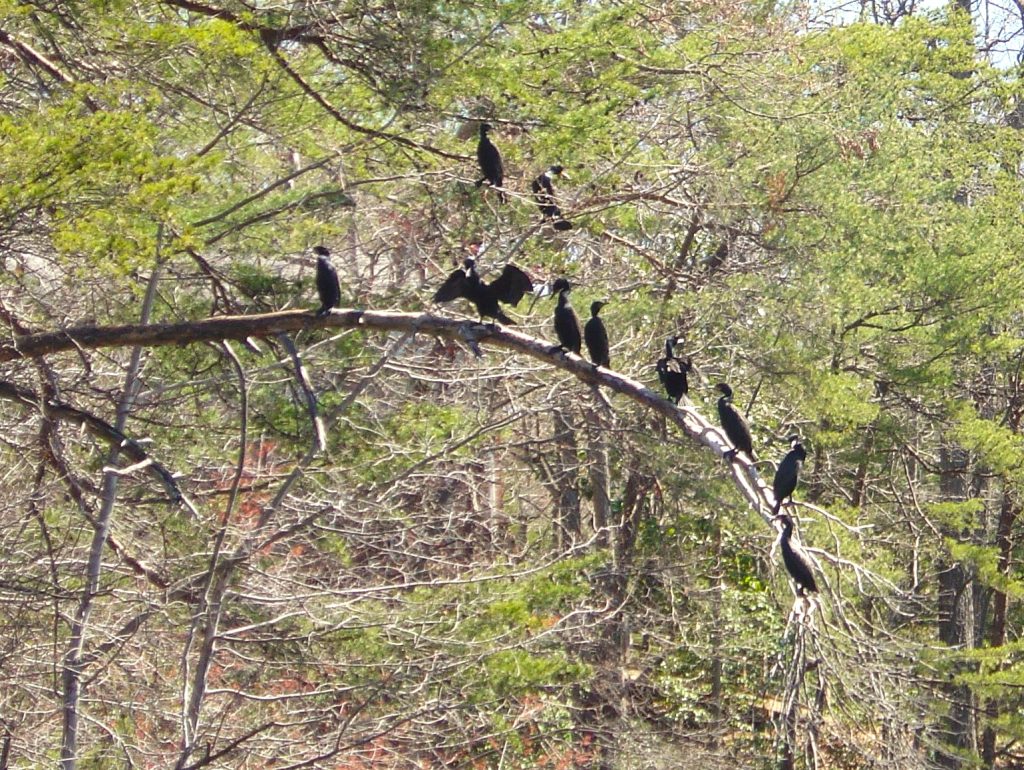
Like most birds, they can perch quite readily on anything, but when walking on land they are downright clumsy. They often perch in great numbers and frequently do so with their wings spread out so their non-waterproof feathers can dry. They can live more than eight years with one banded bird reported to have lived for over 22 years.
An embarrassing confession – in last month’s frog article I wrote that April would be about the Double-breasted Cormorant, but that is wrong, it is Double-crested – I must have been thinking about a blazer, not a bird.
Watch for next month’s nature article on ticks – as we head into tick season, Kevin will have some tips on how to stay safe.
Captions: all photos by Kevin Howe
- Close-up of Cormorant bill, head & eye with feathered crest.
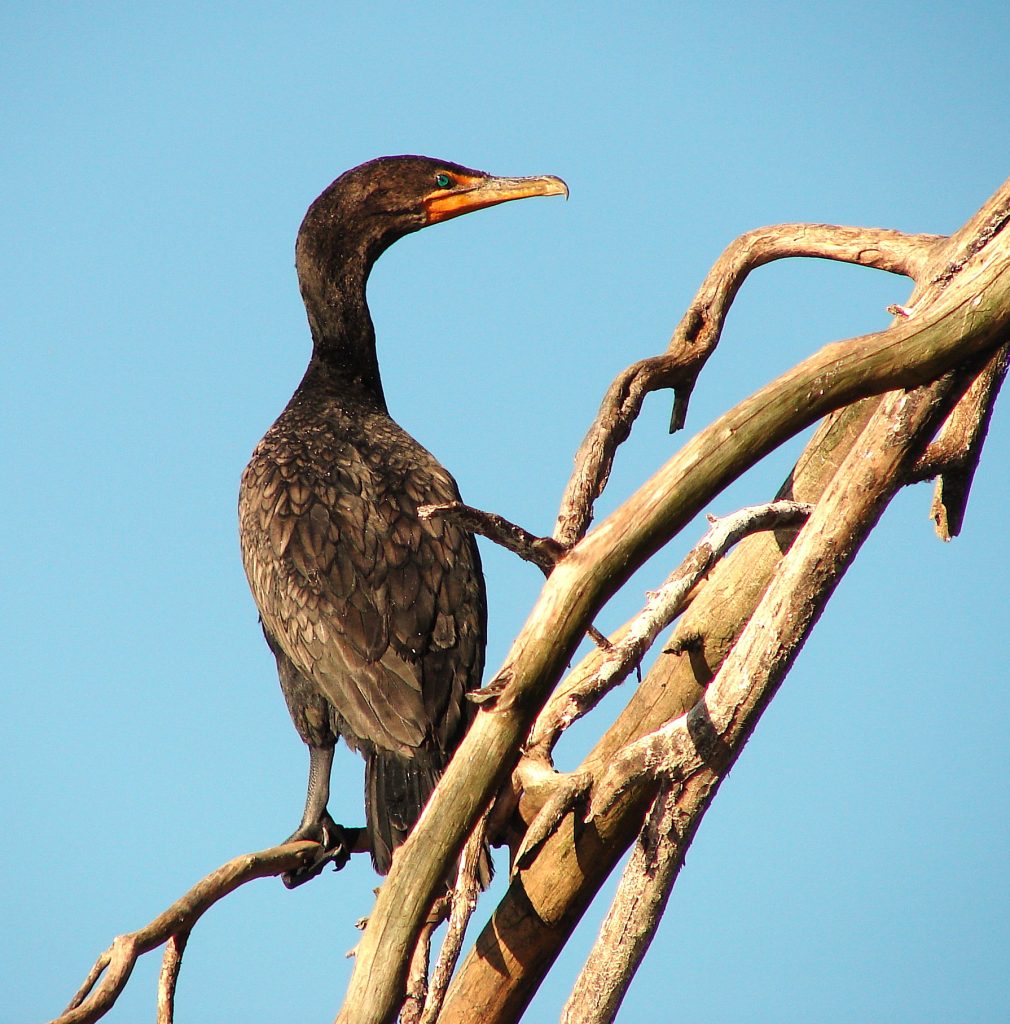
- Non-breeding Double-Crested Cormorant.
- Cormorants hanging out & drying their wings.